Sprengisandur F26: The Final Verdict
Episode 2: The Truth About Glacial Water, Hidden Boulder Zones, and the Grand Finale
Welcome back to the final segment of our deep-dive highland expedition across the legendary Sprengisandur F26 mountain track. In our previous post, we mapped out the foundational logistics, fuel warnings, and the baseline realities of entering Iceland's great central desert void. Now, we are shifting our focus to real-time observations directly from the trail cabin window. This final chapter covers the physical dynamics of river tracking, the invisible dangers of well-maintained paths, and the ultimate visual rewards waiting at the edge of the northern plateau.
The Grader's Illusion: Smooth Trails and Hidden Boulders
During this run across the plateau, we encountered a stroke of excellent logistical luck: the regional heavy-machinery motorway grader had just completed a sweep of the main F26 path. While this makes for incredible, smooth driving conditions in our video footage, it creates a dangerous psychological trap for unwary travelers. A freshly graded trail looks clean, but it can mask structural challenges that require absolute driver vigilance:
When sitting high up in a proper 4x4 mountain vehicle like our heavy pickup fleets, your forward line of sight changes. Large, sharp volcanic rocks and jagged stones sitting directly in front of the bumper can easily disappear beneath the hood's blind spot as you approach them. If you rush down a smooth, graded track, you risk striking these tires-slicing stones at speed. Take it slow and keep your eyes scanning well ahead of the vehicle's nose.
The Danger of Blind Highland Crests
The topography of the F26 features constant undulating waves of volcanic hills and blind crests. A major safety issue occurs when drivers crest a steep hill too fast without seeing what lies on the immediate other side. Heavy spring runoff and passing trucks can dislodge large boulders, leaving them sitting directly in the middle of the trail lane just over the ridge. If you come over a blind rise with too much momentum, you won't have the braking distance to stop before smashing your undercarriage or suspension against a dead-center rock. Crest every hill with caution.
When we rolled through the unbridged river segments on this trip, the water volume was exceptionally low—measuring a manageable 10, 15, to 20 centimeters deep. The river crossings felt like shallow streams. However, you must never let low water levels lower your guard. Glacial rivers are dynamic, unstable systems that can change completely within minutes.
We have navigated these identical crossings when they were swollen over a meter deep, rushing with enough hydraulic velocity to push heavy trucks off line. A sudden burst of warm afternoon sun melting glacier ice caps, or a localized rain shower in the interior, can transform a dry gravel bed into a roaring, impassable torrent by evening. Never assume a river is safe just because a video from yesterday showed it was dry.
The Golden Rules of Fording Glacial Rivers Safely
Because water safety is your primary line of defense against catastrophic out-of-pocket engine bills, incorporate these fieldwork protocols into your mountain travel strategy:
- Wade Before You Drive: If you reach a crossing and cannot clearly see the bottom, or if there are no other vehicles around to verify the path, put on your boots or wading shoes and physically walk the riverbed. Testing the depth and checking for loose sand with your own feet is the absolute safest way to gauge a ford.
- The Patience Protocol: If a river channel looks deep, rapid, or intimidating, do not gamble. Pull over safely to the side of the trail and wait. Watch how an experienced local driver or a larger mountain vehicle tackles the crossing. This reveals the exact depth, underwater boulder obstacles, and the best trajectory from entry to exit.
- Follow, Don't Race: Once a safe path has been established by a lead car, follow their exact track at a safe distance. Maintain steady forward momentum in your low-range 4x4 lock to keep your bow wave clean and your wheels from sinking into vibrating, liquefying sand beds.
The Grand Finale: The Twin Giants of the Skjálfandafljót
After surviving the long hours of the central moon desert, the F26 rewards travelers with one of the most magnificent landscape transitions in the country. As the volcanic sand gives way to the northern valleys, you encounter the roaring glacial waters of the Skjálfandafljót river, home to two off-the-beaten-path waterfall masterpieces:
| Highland Waterfall | Visual Profile & Accessibility Notes |
|---|---|
| Hrafnabjargafoss | A hidden, horseshoe-shaped marvel where the river cascades over a series of staggered basalt cliffs into a turbulent canyon corridor. It is completely wild, lacks safety railings, and offers a raw look at untouched volcanic forces. |
| Aldeyjarfoss | The crown jewel of the northern F26 segment. A powerful, ice-cold 20-meter torrent framed by an amphitheater of symmetrical, twisted black basalt columns. The contrast of brilliant white foam against black volcanic rock is a dream for photographers. |
Plan Your Next Highland Adventure Spot
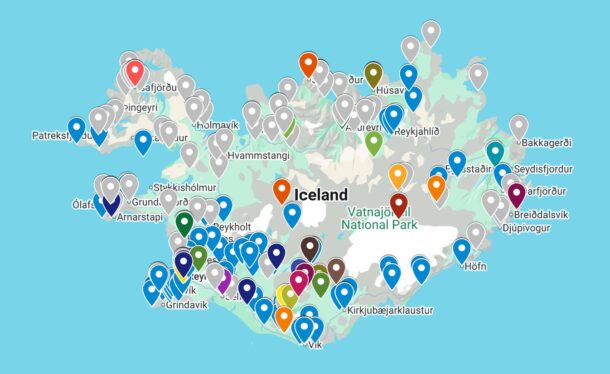
The Sprengisandur trail is a masterclass in self-reliance, driver focus, and raw wilderness travel. To organize your itinerary stops, cross-reference regional points of interest, and map out your next target destination safely from your tablet, explore our comprehensive national database over at the Camper Iceland Places to Visit Guide Index.
By balancing proper safety checks via umferdin.is, matching your vehicle to the terrain, and treating unbridged river beds with absolute respect, you can experience the magical, lonely heart of Iceland safely. Take it slow, enjoy your footage, and explore the interior with confidence alongside Camper Iceland!
🏔️ Sprengisandur F26: Master Highlights & Matrix
Camper Iceland Expedition Planning Resource
The Desert Void: Understanding the Interior
The Sprengisandur plateau is the largest volcanic desert in Iceland. It is a world of monochrome black sands, punctuated only by the white domes of glaciers on the horizon. This route is a seasonal window that typically only opens from **late June to early September**. Navigating it requires more than just a 4x4; it requires a vehicle built for the heavy abuse of washboards and deep river beds. Our THOR and TYR units provide the structural integrity and wading depth to ensure you reach these highlights safely.
Must-See Sights: The "Big Four" of the F26
1. Hrafnabjargafoss (The Horseshoe Fall)
Located just upstream from Aldeyjarfoss on the Skjálfandafljót river, this is a hidden, horseshoe-shaped marvel. The river cascades into a series of jagged basalt crevices and cracks. It is far less crowded than most waterfalls and offers a raw, unprotected look at the sheer power of glacial meltwater.
2. Aldeyjarfoss (The Basalt Theater)
The crown jewel of the Sprengisandur plateau. A massive glacial fall framed by symmetric, twisted hexagonal basalt columns. The visual contrast between the milky-white water and the jet-black rock is unparalleled. It is the perfect reward for finishing the 240km desert traverse.
3. Nýidalur Oasis (The Safety Heart)
The only green oasis in the central desert void. This is the location of the mountain warden huts and the primary river crossing safety checkpoint. Situated under the Tungnafellsjökull glacier, it is the only place to get real-time info on the rivers before you commit to the crossing.
4. Laugafell Geothermal Pool (The Detour)
A 40km detour from the main F26 leads you to a geothermal hot pool on a high mountain ridge. It offers panoramic views of the glaciers while you soak. Logistics Warning: This detour adds 1.5 - 2 hours of driving and significantly increases fuel consumption—plan your tank accordingly!
Expedition Seasonal Matrix
| Month | Track Status | Operational Reality |
|---|---|---|
| Late June | OPENING PHASE | High snowmelt volume. Rivers are at their deepest. Tracks are soft and muddy. |
| July / August | PRIME WINDOW | Road graders have leveled the track. Rivers are stable (but watch for afternoon glacial melt). |
| Early Sept | CLOSING PHASE | Days are short. First snowstorms hit the plateau. High risk of getting stuck in sudden blizzards. |
Plan Every Kilometer Carefully
The highlands allow no room for error. Use our master destination directory to verify your itinerary stops and coordinates before you depart.
Explore Destination Master Index →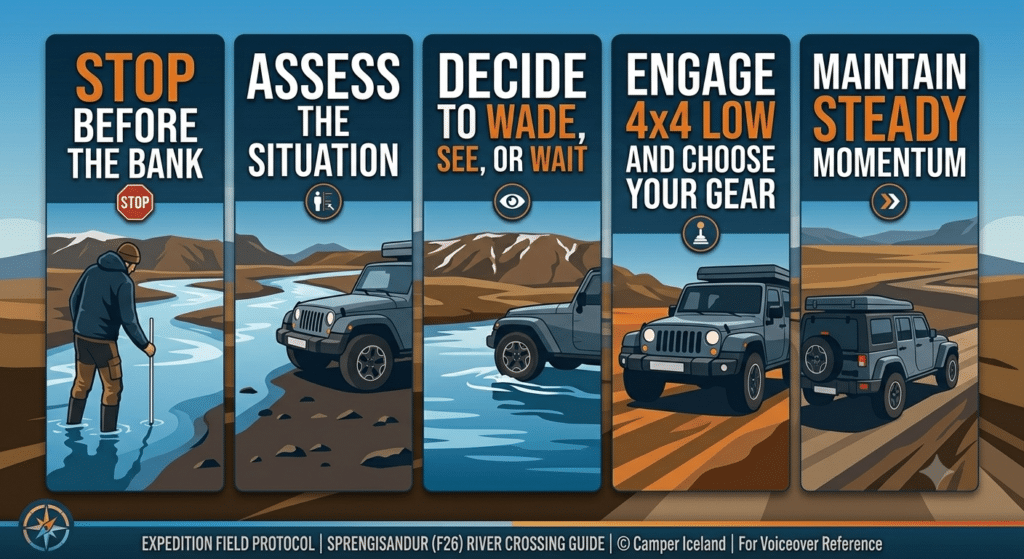
Highland Technical Specifications Matrix
An Expert, Step-by-Step Guide to Vehicle Physics on the Sprengisandur F26 Track
Driving across Iceland's rugged interior plateau requires balancing a sense of adventure with an understanding of basic vehicle mechanics. The tracks are unpaved, undulating, and dynamic. To protect your journey, prevent mechanical wear, and ensure seamless exploration, our engineering team has broken down the core technical parameters of our 4x4 fleets—such as the THOR and TYR—into simple, practical rules. You do not need to be a mechanic to drive the F26, but understanding these fundamental vehicle parameters will keep you safe and confident.
1. The Physics of Tires: Airing Down & Airing Up Safely
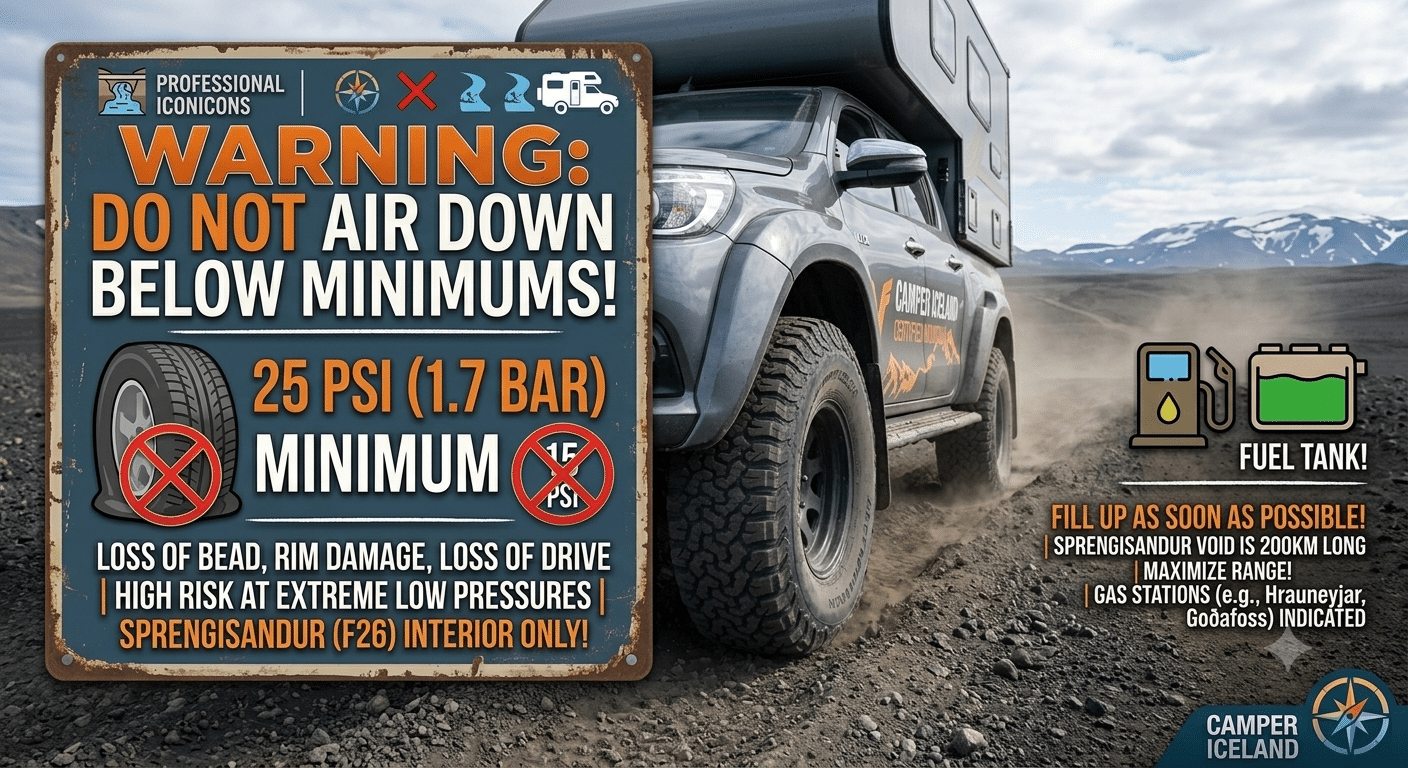
When vehicles leave factory assembly lines, their tire pressures are inflated to standard street-level metrics (usually around 35 to 40 PSI or 2.4 to 2.8 BAR). This hard inflation minimizes rolling resistance on smooth asphalt highways and optimizes fuel efficiency. However, once you transition onto unpaved highland tracks like the F26 Sprengisandur, a rock-hard tire turns into a bouncy springboard, reducing traction and transmitting harsh vibrations directly into your vehicle's frame.
What is "Airing Down" and Why Does It Help?
"Airing down" is the intentional process of releasing a measured amount of air from the tire valve stem to decrease internal pressure. Lowering the pressure allows the rubber tread to become more flexible. This structural softening provides two massive benefits:
- Expanded Contact Patch: The tire gently flattens out against the gravel, creating a larger "footprint" on the ground. This distributes the weight of the camper more evenly, giving you maximum grip over loose sand or mud.
- Natural Shock Absorption: The softer rubber flexes over jagged lava stones, acting as an extra cushion before vibrations reach your suspension system. This significantly reduces long-term component wear.
Releasing too much air introduces severe mechanical risk. If you drop below our mandatory minimum threshold of 25 PSI (1.7 BAR), the tire can lose its structural grip on the metal wheel rim. Under heavy torque or when turning over deep sand, a low-pressure tire can instantly break its bead—releasing all internal air immediately, damaging your wheel rim, and stranding the vehicle.
The Golden Rule: Air Up Immediately at the Next Gas Station
A lowered tire pressure configuration is strictly for low-speed gravel trail use only. Driving soft tires on hard, high-speed asphalt highways causes the sidewalls to overheat rapidly due to friction, which can lead to sudden tire blowouts. The moment your vehicle leaves the F-road grid and hits the hard asphalt Ring Road, you must navigate directly to the very first available fueling station to re-inflate all four tires to standard street pressures using their free air stations.
2. Water Clearance: The Mechanics of Glacial River Crossings
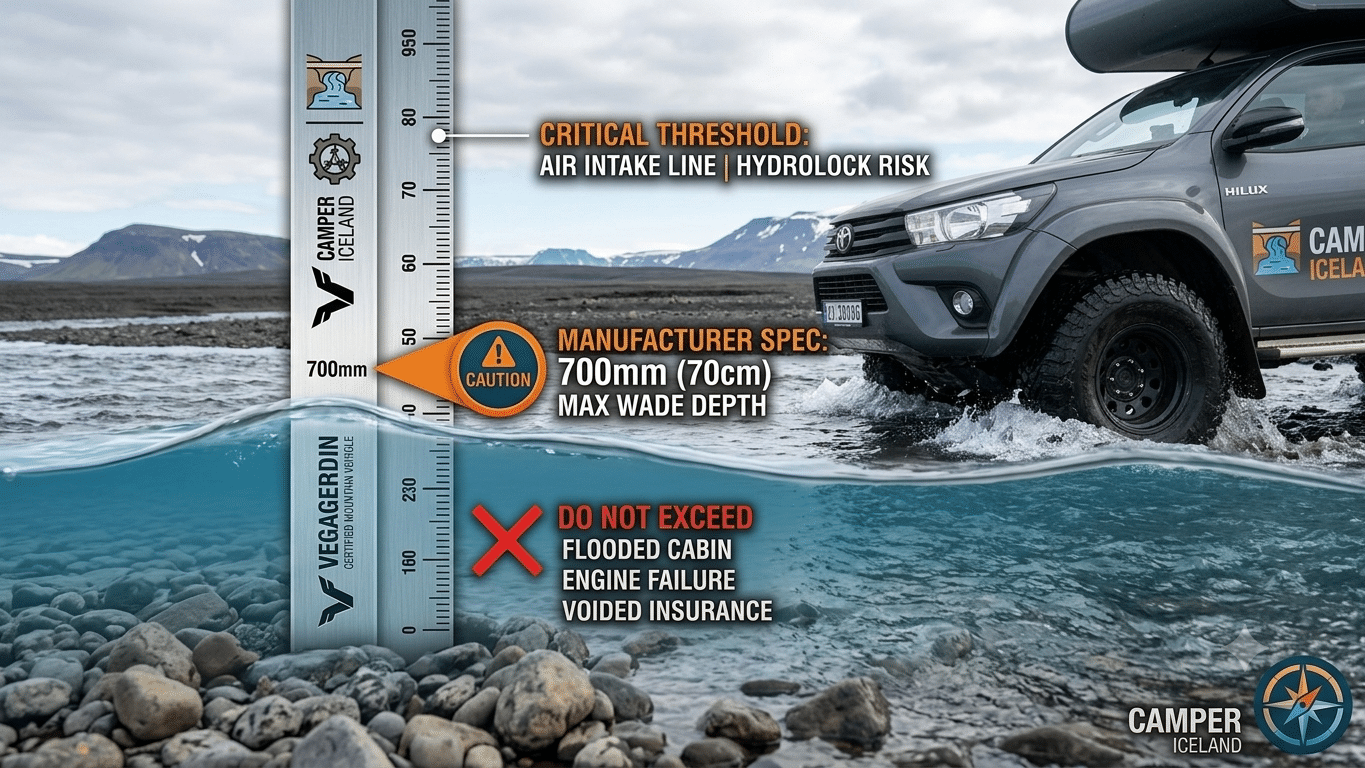
Every vehicle manufacturer tests their platform's air intake placement and electronic sealing to establish an official, maximum safe wading depth. If water passes this line, it will spill directly into the engine's fresh-air intake system, resulting in a sudden engine failure (hydrolock) that is completely excluded from all insurance policies.
The 700mm Fleet Threshold
Our heavy-duty 4x4 camper trucks feature a maximum safe wading depth parameter of 700 mm (70 centimeters). As illustrated in the reference diagram above, this depth marker usually lines up with the upper arch of your wheels. When you perform your physical walking assessment of an unbridged river crossing, if the moving water channel reaches past your knee line or crests higher than 70cm against your legs, **the river is impassable**. Do not attempt to cross. Wait for the water to recede or follow a larger vehicle once conditions stabilize.
3. Other Frequently Asked Highland Technical Parameters
Beyond tires and water clearance numbers, overlanders frequently ask our workshop support desk about other mechanical operations. Here is a quick reference matrix of what is happening under your vehicle's frame:
| Technical Feature | Operational Metric | Why It Matters to Highland Drivers |
|---|---|---|
| 4WD Low Range (4L) | Gear Ratio Reduction | Changes gear settings to maximize wheel torque at low speeds. Essential for pushing heavy camper shells through deep river currents and thick volcanic sand beds without overheating the engine. |
| Underbody Clearance | Approx. 220-240 mm | The physical distance from the lowest point of the vehicle's axle to the ground. Our trucks feature heavy steel underbody skid plates to protect the oil pan from rocks hiding in the middle of deep trail ruts. |
| Center of Gravity | Elevated Apex | Because your truck carries an insulated living cabin, it has a higher center of gravity than a regular car. Drive slowly around sharp gravel curves and avoid sudden steering maneuvers to prevent body roll against high side winds. |
⚠️ Mandatory Expedition Safety Disclaimer
The technical specifications, water depth metrics, tire pressure recommendations, and operational field rules provided in this guide are intended solely as general informational support for travelers. Nature in the Icelandic central highlands is completely unpredictable, and trail environments can alter completely within minutes due to volcanic, meteorological, or thermal changes.
The final operational decision to cross any unbridged river, modify vehicle specifications, or traverse any F-road belongs to you alone. The driver holds full physical and financial responsibility for the safety of the passengers, the vehicle, and all rescue costs incurred. Drive carefully and respect the landscape.
The Camper Iceland Family Legacy
Built by Locals • Driven by Passion • Trusted for Generations
Navigating the rugged spine of Iceland's central interior is a deeply personal journey, and we believe the team backing your vehicle should reflect that. Unlike massive, corporate rental conglomerates managed by distant boards, Camper Iceland is a proud, independent family business. For decades, our family has lived, traveled, and worked right here on this volcanic island. We don't just hand you a set of keys; we welcome you into our local community, sharing real-time field insights, tracking route volatility, and preparing you honestly for the paths ahead.
The Hidden Cost of Highland Wear and Tear
The Sprengisandur F26 is a legendary route, but it is also a relentless machine that tests every weld, bolt, and panel on a vehicle. The extreme, endless corrugated washboards, flying gravel stones, deep ruts, and abrasive black sand create a severe wear-and-tear profile. Standard urban rental cars quickly lose structural integrity here—suffering misaligned wheels, cracked oil pans, stripped bumper mounts, and ruined shock absorbers. These damages inevitably result in staggering out-of-pocket repair bills when returning standard cars. Our family engineers our vehicles specifically to withstand this relentless physical abuse, ensuring your holiday remains an adventure, not a mechanical liability.
When you choose us, you are choosing specialized equipment designed by experts who know what it takes to cross a glacial river safely. We maintain total oversight over our workshop, meaning every truck camper is structurally checked, sealed, and armored before it ever leaves our facility. We treat your safety exactly how we treat our own family's safety.
We Look Forward to Seeing You in Iceland!
Let our family match you with the perfect, heavy-duty mountain companion built to master the interior void.
Sprengisandur F26 Video & Article Index
Master the base parameters of the central void. Covers remote fuel strategy, vehicle wear profiles, and pre-flight mapping safety protocols.
Master live river safety protocols. Covers manufacturer depth limits, tire air physics, blind crest stone fields, and the northern waterfalls.