Driving the Sprengisandur F26 Route
The Ultimate Iceland Highland Guide for Adventurous Self-Drivers
Iceland’s central highlands represent one of Western Europe’s last true wilderness regions—a landscape carved by volcanic fires, sweeping subarctic winds, and shifting glacial tongues. For travelers who want to venture deep into this otherworldly interior, the legendary Sprengisandur route (Road F26) stands out as the ultimate overland challenge. Bisecting the country from south to north, this ancient track routes adventurers directly through a vast black sand desert sandwiched between two massive ice caps: Hofsjökull and Vatnajökull.
However, crossing the dynamic Sprengisandur plateau is entirely different from driving the Ring Road. It requires a meticulous safety strategy, realistic understanding of your vehicle’s mechanical limitations, and deep respect for the volatility of Icelandic weather patterns. This comprehensive guide details everything you need to know to prepare for an unforgettable trip down the F26 without requiring specialized expedition gear like industrial retrieval winches, recovery straps, or shovels. By adopting sound logistics, planning your route carefully, and respecting safety regulations, you can complete this epic crossing seamlessly using a standard production mountain vehicle.
Understanding the Terrain: F26 Sprengisandur vs. F35 Kjölur
When looking at the interior map of Iceland, two distinct arterial routes traverse the island from south to north. Many travelers treat these routes interchangeably, which can lead to hazardous planning errors. Understanding the profound operational differences between Road F26 and Road 35 is essential before entering the highlands.
▼Road 35 (Kjölur)
The Kjölur route runs between the Langjökull and Hofsjökull glaciers. While the track is heavily washboarded, rough, and slow-moving, it has been completely bridged. This means that when you drive Road 35, you will encounter precisely zero unbridged river crossings. It requires a 4x4 configuration mainly due to rough surfaces, steep gravel inclines, and loose stones, but it does not present hydro-mechanical risks to your vehicle's engine.
▼Road F26 (Sprengisandur)
The Sprengisandur route is the longest highland road in Iceland, stretching through a raw volcanic void. Unlike Kjölur, the F26 features multiple unbridged glacial river crossings. These rivers change dynamically based on temperature, sunlight, and rainfall. F26 is deeply rutted, features fields of sharp volcanic rock, and demands high ground clearance alongside a true four-wheel-drive system equipped with low-range capabilities.
While standard 4x4 crossover vehicles (like a Dacia Duster) are legally permitted on open F-roads, attempting the Sprengisandur F26 in one is an extreme risk. The deep, jagged volcanic tracks and brutal washboards act like teeth on small vehicles. Crossovers driven on this route frequently lose body components, lower plastic trim panels, bumpers, and underbody skid plates due to the constant vibrations and rock strikes. This almost inevitably leads to massive out-of-pocket repair costs when returning the car. Furthermore, their lower air intakes put them at constant risk of engine failure in unbridged river segments.
To navigate the F26 comfortably and ensure you can safely stay overnight at remote wilderness hubs like Nýidalur, you require a heavy-duty platform. Our specialized Camper Iceland 4x4 fleets—including the legendary 4x4 Camper THOR and the ultra-robust 4x4 Camper TYR—are engineered precisely on rugged, high-clearance truck chassis (like the Toyota Hilux or Isuzu D-Max). They give you the torque, frame strength, and wading depth required to conquer the sand without turning your vacation into a costly mechanical recovery operation.
The Digital Pre-Flight Check: Monitoring Safety Portals
Before turning your ignition key in the direction of the central highlands, checking live digital safety maps is non-negotiable. Conditions in the volcanic interior can fluctuate drastically within hours due to glacial thermal activity and wind patterns. Make sure to consult these resources every morning on your tablet or mobile device:
- Umferdin.is (Vegagerðin / Road.is): This is the official live map managed by the Icelandic Road and Coastal Administration. It displays real-time road conditions, opening hours, temporary closures, and road surface statuses across the country. If the F26 path transitions from a dotted green line (Passable for Mountain Vehicles) to red, it means the track is closed or impassable due to hazardous mud or overflowing river systems.
- Vedur.is (The Icelandic Meteorological Office): This portal tracks precise weather trends, high-altitude wind currents, and precipitation charts. The central desert plateau functions as an atmospheric funnel between two major ice sheets. High-velocity winds exceeding 20 meters per second can transport volcanic ash clouds, severely limit visibility, and damage door hinges if doors are opened carelessly into the wind.
- Safetravel.is: The ultimate portal for safety alerts, emergency warnings, and leaving your mandatory travel plan with search and rescue teams before heading into zero-reception areas.
Kilometer Calculations: The Main Track vs. Highland Detours
Highland driving is heavily defined by a strict economy of scale. Because you are traveling on slow, high-resistance terrain, odometer tracking is absolutely critical to your safety. Every single kilometer off the beaten path requires meticulous calculation.
The straight line journey across the main F26 Sprengisandur track from Hrauneyjar in the south to the Ring Road (near Goðafoss) in the north spans roughly 240 kilometers. Under standard trail conditions, this baseline drive takes anywhere from 5 to 7 hours of concentrated driving. However, the temptation to stray onto intersecting tracks to view surrounding sights changes your logistical math instantly:
- The Askja Detour (via F910 West): Nestled deep in the Dyngjufjöll mountains, the legendary Askja caldera is an awe-inspiring location. However, attempting to reach Askja from the F26 means branching onto the western segment of the F910 (Gásasandur/Dyngjufjallaleið). The detour from Nýidalur to the Dreki Huts at Askja adds roughly 125 kilometers one-way over brutal, deep volcanic sand tracks and an additional 6 unbridged river crossings. A round-trip detour adds a massive 250 kilometers to your itinerary. For most travelers, Askja should be treated as an entirely separate, dedicated expedition from the north or east rather than a casual side-trip from the F26.
- The Laugafell Detour (via F821 / F752): Sneaking off to the geothermal oasis of Laugafell adds approximately 30 to 40 real kilometers onto your trek, depending on your northern exit point. While highly rewarding for a dip in a hot pool, remember that slow speeds mean this short distance can add 1.5 to 2 hours to your travel day.
Essential Logistics: Fueling Strategy and Food Preparation
Sprengisandur is a vast geological void. Once you enter the track, there are zero commercial gas stations, convenience markets, mechanical service facilities, or grocery outposts. You must be completely self-reliant.
The South-to-North Fuel Mandate
If you are initiating your highland expedition from the southern lowlands, your absolute last opportunity to fuel up your vehicle is in the geothermal town of Hveragerði or the neighboring logistics hub of Selfoss, followed by a final top-off point at the Hrauneyjar Highland Center right before the asphalt transitions into the F-road. Do not bypass these fueling points. Operating a vehicle over deep, loose sand, corrugated washboards, and rocky paths utilizing a four-wheel-drive low lock mechanism consumes fuel at nearly twice the rate of standard highway driving. Enter the F26 exclusively with a 100% full fuel tank.
While you must ensure your vehicle is mechanically sound and fully fueled, you do not need to pack professional expedition machinery like heavy metal shovels, recovery winches, tree trunk protectors, or military-grade kinetic ropes. Our Camper Iceland mountain vehicles are engineered to withstand these paths naturally. Instead, focus your preparation on foundational human provisions: pack high-energy food, multiple liters of clean drinking water per passenger, warm windproof clothing layers, and a reliable charging cable for your mobile communication equipment.
The High Cost of Water: Insurance Realities & River Crossings
The number one source of vehicle damage in the Icelandic highlands is catastrophic engine flooding caused by reckless river crossings. It is vital to understand the financial liabilities before moving into the water.
Almost all standard rental vehicle protection packages, including Super Collision Damage Waiver (SCDW) and general comprehensive gravel protections, explicitly exclude any water damage caused by crossing rivers or body-of-water submersion. If you drive a vehicle into an unbridged river and the engine draws water through the air intake system, the engine block will suffer hydrostatic lock. This destroys the motor instantly. The resulting vehicle replacement, long-distance remote towing fees, and structural mechanical repairs are 100% out-of-pocket expenses for the driver, often totaling tens of thousands of Euros.
Note: In our upcoming video segment, we will demonstrate the step-by-step physical mechanics of safely crossing an unbridged glacial river, including assessing water depth, mapping a downstream path, and maintaining a steady bow wave. For now, remember this foundational rule: if you approach a crossing and cannot clearly gauge the depth, or if the water level rises above your vehicle's wheel line, park safely on the bank and wait for an experienced mountain driver or local highland warden to cross first.
Preserving the Wild: The Strict Illegality of Off-Road Driving
When you stand in the middle of Sprengisandur, surrounded by thousands of square kilometers of black sand deserts, it can look like an open playground with no boundaries. However, off-road driving is strictly illegal in Iceland and carries massive criminal penalties, including fines up to $10,000 USD, vehicle impoundment, and judicial prosecution.
Subarctic volcanic soils and moss ecosystems are fragile. Tire tracks pressed into delicate volcanic ash or moss-covered fields can cause severe wind erosion, leaving permanent scars that take decades or centuries to heal. Driving off the clearly marked trail borders damages the environment and makes you deeply unpopular with local search and rescue teams, conservation rangers, and the Icelandic community. Stay firmly within the defined, graded path of the F26 at all times.
What to Explore: Iconic Highlights Along the F26
The Sprengisandur track is a gateway to some of the most stark, desolate, and captivating geographical landmarks in the North Atlantic. Keep your camera close by as you navigate near these key coordinates:
| Destination Location | Approximate Region | Geographical Highlight & Significance |
|---|---|---|
| Aldeyjarfoss Waterfall | Northern Terminal | An amphitheater of symmetric, twisted black basalt columns framing a powerful glacial waterfall fed by the Skjálfandafljót river. One of the most photogenic geological sites in Iceland. |
| Nýidalur (New Valley) | Central Plateau | The primary safety oasis of the interior. Located right in the middle of the F26, this green valley features a seasonal warden cabin, basic emergency huts, and primitive camping zones. It provides an essential safety checkpoint to review river conditions and relax securely. |
| Tungnafellsjökull Backdrop | Central-East | A massive, imposing glacier that flanks the eastern boundary of the Nýidalur pass, offering sharp contrast between pristine ice domes and volcanic black deserts. |
| Laugafell Oasis | North-West Detour | A geothermal hotspot located slightly off the main F26 path, featuring a natural geothermal pool where travelers can soak and rest amidst the cold highland winds. Requires calculation for fuel efficiency due to additional track kilometers. |
Access Our Local Infrastructure Resources
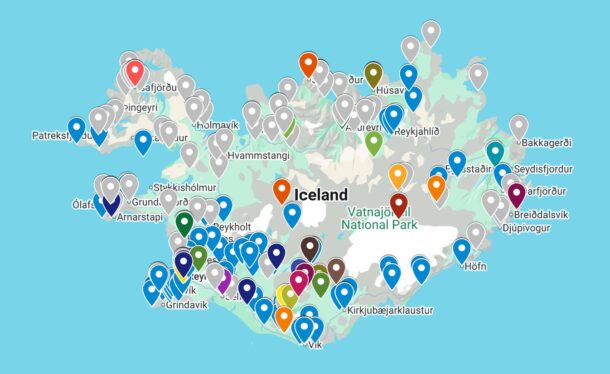
To help map out your baseline parameters, track historical local details, and organize your daily route itinerary, head over to our real master library directory at Camper Iceland Places to Visit Guide Map. You can use this catalog to cross-reference geographical coordinates and pinpoint safe spots to drop anchors before entering unbridged tracks.
Before you depart tomorrow morning, review our destination mapping index on your tablet, download the offline regional map package via Google Maps so you preserve tracking capabilities without cellular service, check umferdin.is for the green status, and take your time. Enjoy the raw majesty of Sprengisandur safely with Camper Iceland!
Sprengisandur F26 Video & Article Index
Master the base parameters of the central void. Covers remote fuel strategy, vehicle wear profiles, and pre-flight mapping safety protocols.
Master live river safety protocols. Covers manufacturer depth limits, tire air physics, blind crest stone fields, and the northern waterfalls.