Icelandic Traffic Act Decoded:
The Complete Guide to Laws, Fines, and License Rules
Planning an unforgettable road trip across Iceland's majestic landscapes? Skip the dry legal jargon. Below is the ultimate, transparent, human-translated breakdown of the Icelandic Traffic Act (Umferðarlög nr. 77/2019) paired with live penalty data, real-world survival strategies, and an interactive index.
Type any keyword below (e.g., "roundabout", "moss", "bridge", "speeding", or "license") to filter the entries instantly!
Top 10 Most Common Road Hazards & Mistakes
Before diving into the full text of the traffic act, let's look at the real-world scenarios. These are the top ten mistakes foreign drivers make on Icelandic roads, along with the real financial impacts.
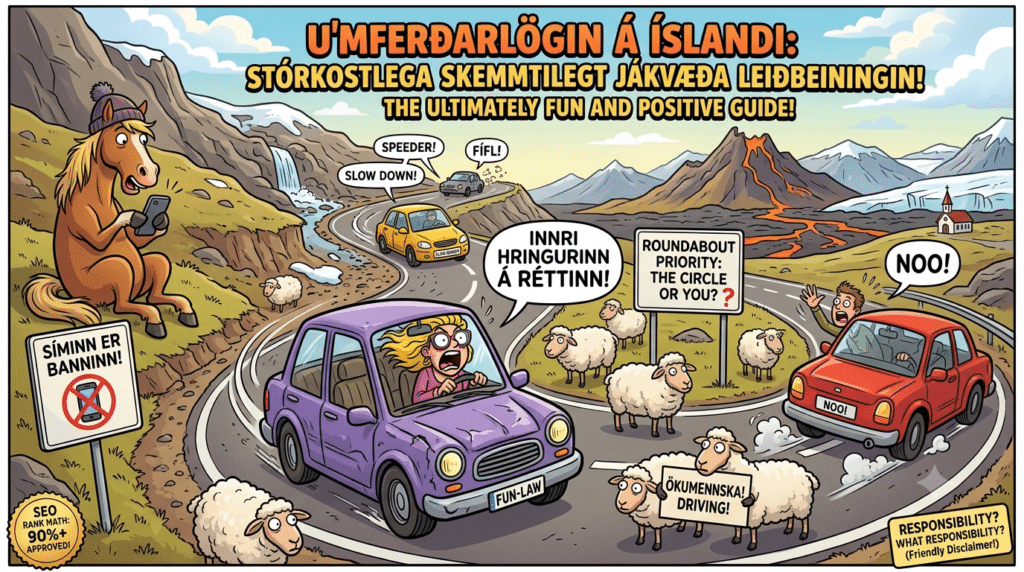
In most countries, the outer lane has priority. In Iceland, the inner lane holds absolute right-of-way to exit. If you are on the outer ring, you must legally yield to anyone cutting across from the inside ring. Blocking an inside vehicle will result in an immediate traffic fine of roughly 50,000 ISK ($360 USD).
Pulling your wheels off the asphalt onto soft moss patterns for a quick photograph is strictly illegal. Sub-arctic moss takes up to 70 years to recover from tire tracks. Fines for environmental damage are severe and start at 350,000 ISK ($2,500+ USD).
The rural Ring Road still contains narrow bridges wide enough for exactly one vehicle at a time. The legal rule is absolute: the vehicle closest to the bridge entrance holds right-of-way. Slow down, check for headlights, and proceed with caution.
Cruising at 90 km/h feels great until the paved road instantly transitions into an unpaved gravel track. Failing to reduce your speed before this line will cause your tires to lose all traction, making the car slide out exactly like it's on loose marbles.
Many country highways peak sharply over steep ridges without any forward visibility of oncoming traffic. Overtaking slower vehicles or stopping anywhere near a blind crest is highly illegal. Keep your vehicle positioned strictly to the far right side of your lane.
Because the summer midnight sun stays incredibly bright all night long, visitors assume they don't need headlights. Icelandic law requires your running lights to be switched on 24/7, day or night, to maintain clear tracking visibility through sudden dust or ocean fog layers.
Violent Icelandic wind gusts can instantly catch an unsecured car door and warp it completely backwards against its structural chassis hinges. Always hold onto your door frames with both hands when stepping out, and try to park directly facing into the wind path.
Mountain interior F-roads feature deep, unbridged glacial river crossings. Standard camper rental insurance completely excludes water damage. If your engine stalls or floods mid-stream, you hold full personal liability for the astronomical structural recovery and engine costs.
During summer months, livestock wander completely free along highway margins. Sheep hold structural right-of-way by default, and their erratic reactions are highly unpredictable. If you spot a lamb near the road, expect it to suddenly bolt across your lane to find its mother.
Speed tracking cameras are quietly housed inside unassuming gray pillars scattered along highways and deep within mountain tunnels. There are no flashing sirens; violations generate automatic digital citations forwarded straight to your rental agency alongside localized credit card surcharges.
Official Traffic Act Deep-Dive (Umferðarlög)
For the meticulous planners, here is the paragraph-by-paragraph breakdown of the official provisions.
This chapter establishes why the act exists and maps its strict legal jurisdiction over public roads, private paths, and off-road environments.
English: Article 1. Objectives: The primary objective of this law is to maximize traffic safety to protect the lives and physical wellness of all road users equally, while ensuring deep respect for the environment.
English: Article 2. Scope: These mandates govern standard public road traffic, but they also maintain absolute jurisdiction over motorized travel completely off paved tracks, mountain trails, and interior plains.
English: Article 4. General Duties: Every road user must operate with baseline consideration and care. You are legally forbidden from obstructing, delaying, or endangering traffic needlessly, and you must respect the peace of roadside residents.
English: Article 8. Positioning: Iceland drives on the right side of the road! Keep your vehicle aligned as close to the right edge of the lane as safely possible, factoring in actual environmental conditions.
Ökumaður á ytri hring skal veita þeim sem ekur á innri hring forgang út úr torginu. Óheimilt er að skipta um akrein í hringtorgi.
English: In a multi-lane roundabout, vehicles operating on the inner lane hold ultimate priority to exit. Anyone traveling on the outer ring must yield to allow them to cross paths and exit cleanly. Mid-loop lane changes are entirely illegal.


- Inner Lane Exits: The inner lane car always owns the track when cutting across to leave.
- Outer Lane Yields: If you are cruising along the outer ring, you must yield to let the inner vehicle cross safely.
- Select Lane by Destination: Choose your lane before entering. Use the Right Lane if you plan to exit immediately at the 1st exit. Use the Left Lane to enter the inner circle if you are taking the 2nd exit (going straight through) or beyond.
- No Lane Changing: Switching lanes while looping inside the track is strictly prohibited. If you pick the wrong lane, commit to it, exit safely, and turn around later.
- Truck Space: Heavy commercial trucks or long trailers occasionally require the outer lane for physical clearance due to their length. Give them plenty of room!
English: Article 22. Standard Speed Limits: Limits are set strictly at 50 km/h in urban towns, 90 km/h on paved rural highways, and a firm 80 km/h on country gravel roads. Speed must always match visibility and weather conditions.
English: Article 28. Parking Regulations: Never park where it creates a dangerous blind spot or bottleneck. Parking right on sidewalks, bicycle lanes, roundabouts, or directly on a blind hill crest is completely prohibited.
English: Article 31. Running Lights: Headlights or verified daytime running lamps must stay lit 24/7. Day or night, summer sun or winter blizzard, if the vehicle is moving, the lights must be shining.
English: Electric scooters and bikes belong on designated paths when available. If riding along a shared standard pedestrian sidewalk, walking foot traffic holds complete right-of-way.
English (Smartphones): No handling smartphones, cameras, or tablet screens manually while operating the vehicle unless using a fully hands-free Bluetooth setup.
English (Off-Road Driving): Off-road driving is entirely prohibited. Zero exceptions. Driving across delicate sub-arctic moss or volcanic soil permanently scars the ecosystem for decades and faces massive penalties.
English: If an accident occurs, you must stop instantly. Help anyone injured, secure the perimeter, and immediately dial the National Emergency Line at 112 if injuries or structural infrastructure damage occur.
A quick-reference administrative summary of the final technical segments governing state enforcement codes:
- Chapter X (Licenses): Sets parameters for global driver's license validity, physical health updates, and testing criteria.
- Chapter XI & XII (Vehicle Specs): Governs vehicle safety registration protocols, required inspection windows, and heavy freight truck specifications.
- Chapter XIII (Legal Sanctions & BAC): Houses the penalty tracking systems for driving under the influence (any blood alcohol level above 0.2‰ BAC leads to license loss), vehicle impoundment rules, and points systems.
- Chapter XIV (Execution): Details state ministerial authorizations and how police deploy highway traffic decrees.
Global Driving License Validity Requirements
✈️ Short-Term Tourists & Vacationers (Up to 3 Months)
If you are visiting for a vacation, you can legally drive using your standard national driver's license from home, provided it meets these baseline criteria:
- The license is completely active and has not expired.
- It features a clear identification photograph of your face.
- The Alphabet Rule: The text details must be printed using the Latin (Roman) alphabet (e.g., English, Spanish, French, German, etc.).
🏠 Permanent Residents & Expats (Over 6 Months)
Once you acquire long-term residency markers in Iceland, your foreign home license is only valid to operate local vehicles for your first 6 months. To continue driving, you must convert it:
- EEA/EU Countries, UK, Switzerland, & Japan: You qualify for a Direct Administrative Exchange. You can simply trade your foreign license for a local one after a quick vision verification, without any testing.
- United States, Canada, Australia, & Rest of World: You must undergo a Tested Exchange. You are required to pass a 50-question digital theory law exam and a practical driving test with Frumherji.
🔗 Verified Government Portal Directories
Avoid guesswork or unverified forum advice. Use these direct, official authority portals to monitor rules, update documents, or book legal testing sessions:
- Review full license conversion procedures on the Island.is Foreign Licensing Portal.
- Find your regional administrative office center through the Icelandic District Commissioners (Sýslumenn) Directory.
- Track formal technical transit vehicle classifications via the Icelandic Transport Authority (Samgöngustofa) Website.
Read the exact full legal compilation directly at the Althingi Website. Have a brilliant, safe journey! 🇮🇸