ℹ️ Note for explorers: Above is our complete English overview tracking highland navigation. If you prefer our original German video asset, it is embedded in the dedicated section near the footer.
Venturing past the perimeter asphalt of the Ring Road and climbing up into the deep, volcanic interior of the Highlands is an unparalleled adventure. To ensure you handle these remote landscapes with total authority, mastering the official 4x4 driving guidelines in Iceland is essential for keeping your travel group secure, confident, and on track.
A rugged truck-bed 4x4 camper is significantly heavy and a lot larger than common SUVs . Because the living habitat is installed on the truck bed and strapped down securely with chain loops , defensive operations, vehicle weight distribution awareness, and strict speed controls are mandatory to stay safe . Below is the ultimate operational manual derived directly from our certified fleet instructions .
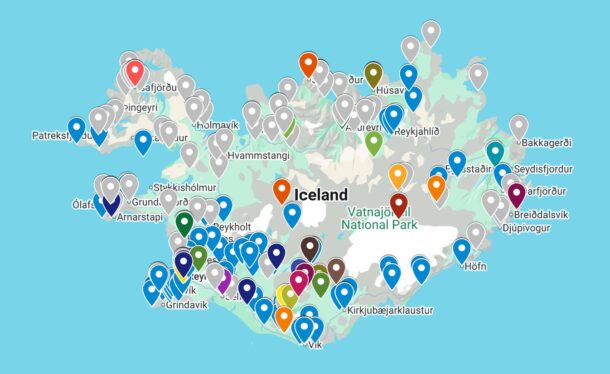
🌐 Live Trackers: Is the Interior Open?
Highland tracks are dictated fully by changing seasonal thaws. Never guess if a trail is open—cross-reference these central portals every single morning:
📉 Tracking Physics: Gravity, Slopes & Incline Management
Operating on unpaved mountain switchbacks requires you to anticipate surface physics shifts carefully . Loose gravel layers drastically extend your required braking distances and reduce your steering traction .
🧗 Climbing Protocols
Use a low gear and get a firm grip on the steering wheel to maintain smooth momentum . **If your engine stalls on a steep hill, push the brake pedal immediately and apply the parking brake .** Shift the transmission to Reverse (R), release the parking brake, and slowly back down the hill as straight as possible . Never attempt to shift into Neutral (N) to regain forward momentum .
📉 Descending Protocols
Always keep your vehicle headed straight down the incline . Avoid turns that take you across the incline of the hill, as narrow track widths increase rollover risks under side load . Use a low gear so engine drag can help the brakes . **Never go downhill with the transmission in Neutral (N)**; this "freewheeling" style can cause your brakes to rapidly overheat and fade .
⏳ Mud, Sand, & Snow
Loose surfaces reduce traction, altering steering, accelerating, and braking . In deep mud, keep moving in a low gear so you do not get stuck . If you let your tires spin at high speed when stuck, they can explode and cause serious injury . Spin the wheels as little as possible and avoid going above 35 mph (55 km/h) .
⚠️ Critical Safety Note: The Transfer Case Rule
If you stall on a hill and decide to leave your vehicle to get help, apply the regular brake, set the parking brake, and shift the transmission to Park (P) . But do not shift the transfer case to NEUTRAL . Shifting the transfer case to NEUTRAL can cause your vehicle to roll even if the transmission is securely in PARK, because the transfer case neutral setting completely overrides the transmission lock ! Leave it in a valid 4-wheel drive gear setting instead .
⚙️ Operating Your Drivetrain: Hilux, Navara, & D-Max Blueprints
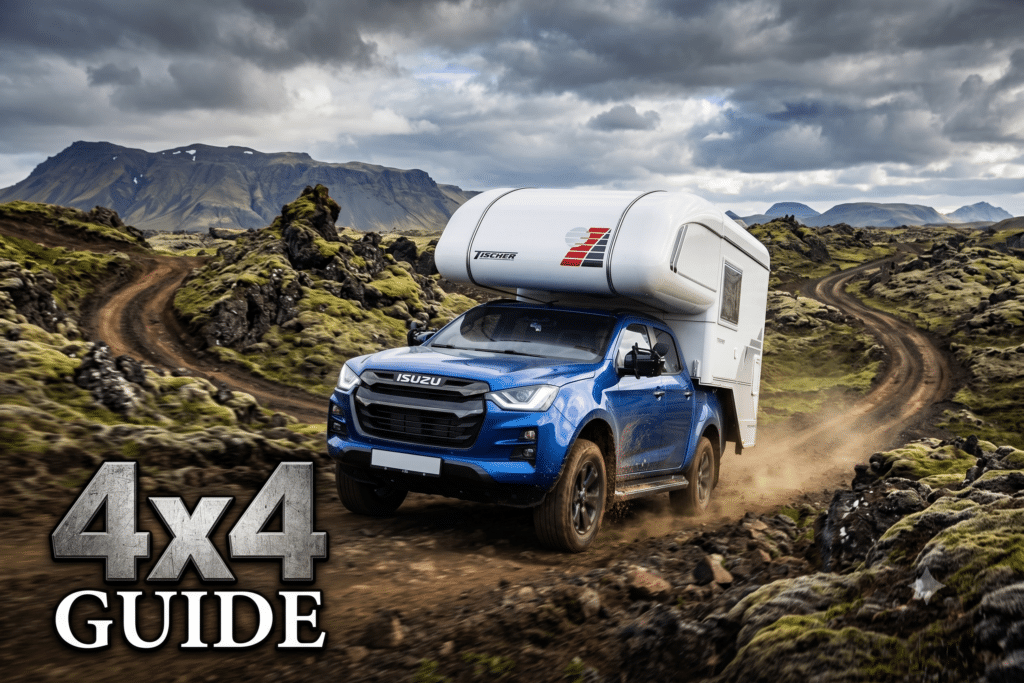
Our rugged modern 4x4 campers (built on premium platforms like the Toyota Hilux, Nissan Navara, and Isuzu D-Max from 2017 and newer) feature shift-on-the-fly digital drivetrain dials located right on the central console panel.
Understanding these three primary operational modes ensures you do not strain mechanical components or lose critical traction on rocky corridors:
- 2H Two-Wheel Drive High Range: Sends power exclusively to the rear axle. Use this mode for normal, dry asphalt driving on the main Ring Road to minimize fuel overhead and component wear.
- 4H Four-Wheel Drive High Range: Electronically locks the front and rear axles together for synchronized traction. Shift into 4H immediately upon encountering unpaved gravel roads, wet mud layers, packed snow tracking, or washboard corrugated paths.
- 4L Four-Wheel Drive Low Range: Provides maximum mechanical torque reduction at highly reduced speeds. To engage 4L, you must bring the vehicle to a complete, dead stop, press the clutch pedal fully down to the floorboards (or shift your automatic transmission to Neutral), and turn the dial control to 4L. Shift into 4L for steep mountain tracking, deep sandy beach conditions, or before entering any water channel.
🌊 Tactical Fording: The Official River Crossing Checklist
Un-bridged river crossings are the ultimate test of highland situational awareness. Glacial rivers are highly dynamic ecosystems; their water currents fluctuate wildly based on daytime temperatures, geothermal melting speeds, and sudden highland rainfall patterns . A ford that was safely shallow in the morning can easily become a deep, raging torrent by afternoon as glacial ice melts under the sun.
 Diagram Overview: Mapping the entry trajectory angle relative to downstream flow currents.
📋 Operational Protocol for Crossing Un-Bridged Streams:
- Stop and Analyze: Find out how deep the water is before you try to drive through it . Observe the surface parameters, boulders, and exit pathways carefully.
- Gauge the Depth: If the water level is deep enough to cover your wheel hubs, axles, or exhaust pipe, do not try it —your vehicle probably will not get through, and water that deep can instantly damage vital mechanical systems .
- Engage Low Range: Bring your truck to a complete stop, drop the transmission into Neutral, and select your lowest 4x4 low gear setting to ensure smooth engine performance.
- Drive Slowly: Enter the water slowly . At faster speeds, water splashes onto the ignition system and causes the vehicle to stall . Stalling will also occur if the tailpipe gets completely submerged under water .
- Test Your Brakes: Once you successfully cross through the water channel, remember that wet brakes take longer to stop . Pump your brake pedal lightly immediately after exiting to dry out the linings and restore regular braking friction.
🛡️ Pro Defensive Tactics for Mountain Passes
Bypassing hidden hazards requires a specialized driving posture. Keep these secondary rules from our operational fleet checklist close in mind:
- 💡Continuous Day Headlamps: Icelandic law dictates that headlights must remain turned on at all times, even during clear daylight hours . This ensures your large vehicle profile remains instantly visible to oncoming trail traffic over blind hill crests .
- 🦺Chain Tension Monitoring: Check your external camper connection tie-downs periodically during off-road sections. Always ensure the securing chains are tightened correctly—never loose, but never over-tightened to avoid structural strains .
- 🔵Blue Recommended Speed Signs: When approaching gravel road corners or steep road turns, look for blue signs displaying recommended travel speeds . Adjust your speed before you enter the curve while your front wheels are still pointing straight ahead .
- 📯Sound the Horn at Hill Crests: Driving over the top of a hill at full speed can cause severe collisions due to hidden drop-offs, embankments, or blind opposing traffic . Slow down as you approach the top, and sound your horn to warn incoming vehicles of your position .
🔧 Post-Expedition Underbody Maintenance
After completing an intensive F-road route track, safely pull over to remove any brush or debris that has collected on your underbody, chassis, or under the hood . These material accumulations can become severe fire hazards when resting against hot exhaust components . Check your core body structure, steering line linkages, suspension dampers, and brake linings for unexpected rocks or glaze before returning to high-speed asphalt lanes .
🇩🇪 Originale Deutsche Version (Allrad- und Hochland-Sicherheit):
Für unsere deutschsprachigen Kunden haben wir hier das umfassende Schulungsvideo mit allen Details zur sicheren Flussüberquerung im Originalton hinterlegt:
🛠️ Need Priority Operational Support?
If you encounter unexpected trail updates, dynamic river surges, or have technical gear dial questions on your journey, utilize our priority digital framework immediately:
- 🌐 **Priority Support Node:** Access our centralized help console directly at support.campericeland.is to bypass standard communication queues .
- 🤖 **Live Manual Chatbot:** Chat with our digital co-pilot anytime via our web console to fetch step-by-step mechanical parameters for Toyota, Isuzu, and Nissan truck platforms instantly.